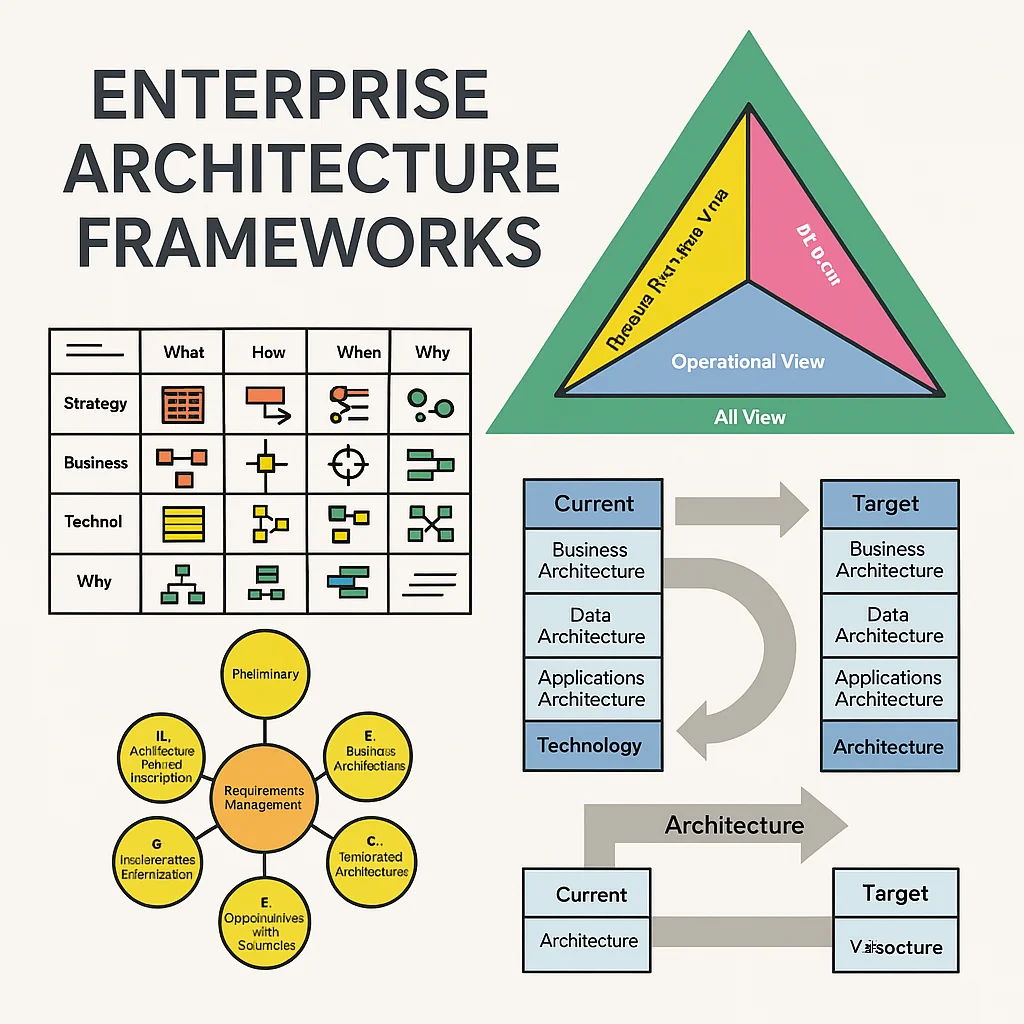

Choosing the Right Enterprise Architecture Framework
Enterprise Architecture is one of those disciplines that feels both essential and strangely abstract.
If you’ve ever been involved in a transformation project, you’ve probably heard someone say:
“We need a framework.”
And that’s where the trouble begins.
Between TOGAF, Zachman, FEAF, and DoDAF, figuring out the right approach can feel like choosing a religion. Some teams swear by TOGAF’s structure, others see Zachman as the only true north, while public-sector folks will tell you FEAF is the only safe path.
The truth is more nuanced: no single EA framework fits every organization. Some are better for large enterprises with heavy governance, others for engineering-driven environments, others for organisations just trying to bring some order without drowning under process.
This article breaks down the major frameworks, compares them clearly, and helps you identify which one matches your organisation’s size, culture, and goals.
The Major EA Frameworks
Below are the four frameworks most commonly referenced and actually used in practice.
TOGAF (The Open Group Architecture Framework)
What it is
A process-driven EA framework built around the ADM (Architecture Development Method). It structures architecture into phases (Vision → Business → Data → Application → Technology → Implementation → Governance).
Why people like it
- Offers a complete method from start to finish.
- Great if you’re formalising an EA practice for the first time.
- Large community, certification paths, and tooling.
Where it struggles
- Can feel heavy if applied “by the book”.
- Requires tailoring, otherwise you end up with hundreds of unused artefacts.
Best for
Large organisations or any company building a structured EA function.
Zachman Framework
What it is
A classification schema — not a process. Six interrogatives (What, How, Where, Who, When, Why) × six stakeholder perspectives.
Why people like it
- Brilliant for identifying gaps in architecture documentation.
- Gives a clear, holistic map of everything that should exist.
Where it struggles
- No guidance on how to build or run architecture.
- Can be perceived as theoretical or rigid.
Best for
Organisations with scattered architecture artefacts needing structure and consistency.
FEAF (Federal Enterprise Architecture Framework)
What it is
A U.S. federal-born framework emphasising standardisation, mission alignment, and portfolio governance.
Why people like it
- Very strong on governance and reference models.
- Good alignment with public-sector operating models.
Where it struggles
- Can feel over-bureaucratic for private-sector companies.
- Limited adoption outside government.
Best for
Public institutions or heavily regulated corporations.
DoDAF (Department of Defense Architecture Framework)
What it is
A framework crafted for defence and complex systems engineering. Heavy focus on capability modelling, data exchange, and operational/system views.
Why people like it
- Excellent for systems-of-systems and multi-supplier environments.
- Ideal where interoperability and traceability are critical.
Where it struggles
- Overkill for standard enterprise IT landscapes.
- Requires engineering-oriented modelling skills.
Best for
Defence, aerospace, industrial systems, and large-scale integrations.
Comparison Summary
| Framework | Type | Focus | Ideal For |
|---|---|---|---|
| TOGAF | Process/method | Business–IT alignment, lifecycle | Large enterprise, mature EA |
| Zachman | Taxonomy | Artefact classification | Structuring existing architecture |
| FEAF | Governance & reference | Standardisation, mission alignment | Public sector / regulated |
| DoDAF | Systems engineering | Interoperability, capability views | Defence / complex ecosystems |
How to Choose Based on Your Organisation
1. Small or mid-size company with no EA yet
- Start with TOGAF, but only the minimal ADM cycles.
- Avoid heavy meta-models; focus on business & application layers first.
2. Large enterprise with many architects but low consistency
- Use Zachman to classify artefacts and expose gaps.
- Layer a lightweight TOGAF-inspired process on top.
3. Government or compliance-heavy environment
- FEAF usually fits naturally.
- Strong governance → strong documentation requirements.
4. Engineering + defence + multi-supplier integrations
- DoDAF is purpose-built for this.
- Great for operational, system, and technical standard views.
5. Your organisation is transformation-driven but wants agility
- Use TOGAF (tailored) + lightweight elements of Zachman.
- Keep the focus on roadmaps and capability planning.
Final Thoughts
EA frameworks aren’t meant to be followed blindly.
They’re toolkits — and a good architect tailors the toolkit to the culture, the strategy, and the stakeholders.
If there’s one universal rule, it's this:
Choose the framework your organisation can commit to, not the one that looks the most impressive.
Start small, validate value early, and let your framework evolve with your business — not the other way around.